1. Understanding US CPSC 16 CFR Part 1262 for Magnetic Entertainment Products
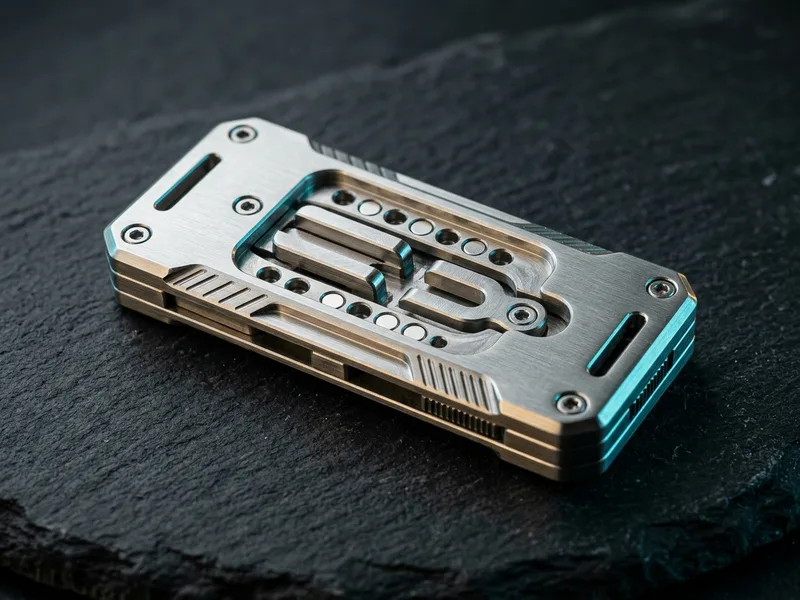
Under the U.S. Consumer Product Safety Commission (CPSC) Safety Standard for Magnet Sets and Entertainment/Stress-Relief Products (16 CFR Part 1262), consumer products designed for mental stimulation or stress relief that contain magnets are strictly regulated to prevent high-powered magnet ingestion hazards.
Specifically, 16 CFR Part 1262 establishes two fundamental engineering rules for importers and private-label brands:
- Small-Parts Cylinder & Flux Index Threshold: Any loose or separable magnet that fits entirely within the CPSC small-parts test cylinder (**31.7 mm diameter × 57.1 mm depth**) must have a magnetic Flux Index ($\text{kG}^2\text{mm}^2$) of **less than 50**.
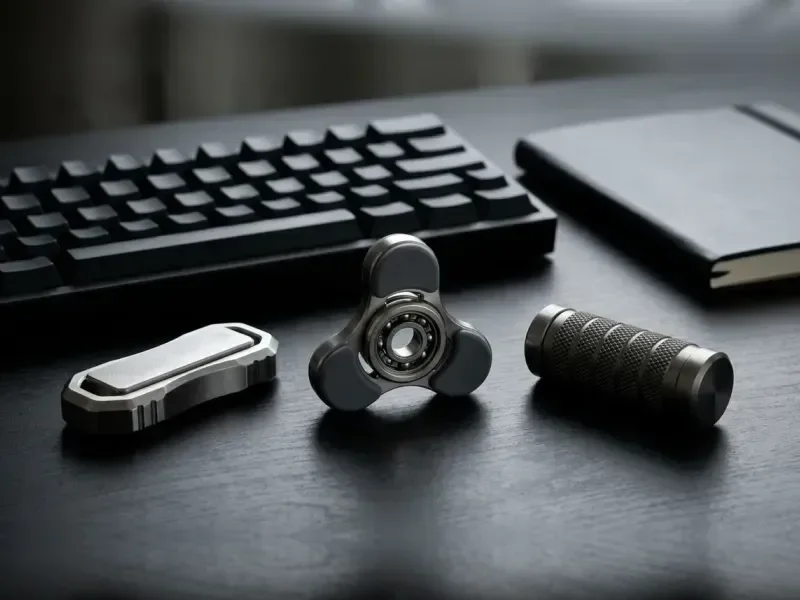
- Non-Liberation of Embedded Magnets: Because complete metal EDC sliders, coins, and gourds (typically 38 mm to 99 mm wide) are either larger than the small-parts cylinder or house internal magnets inside heavy metal shells, compliance requires that **internal neodymium magnets never detach or liberate** during drop, torque, and tension abuse testing.
Why is this the #1 priority for Amazon FBA and retail distributors?
If a single customer reports that a small Ø5×2mm neodymium magnet fell out of a cheap slider, Amazon’s automated safety team can suspend the ASIN immediately pending a 16 CFR 1262 test report.
2. Our 3-Layer Anti-Detachment Magnet Retention Protocol
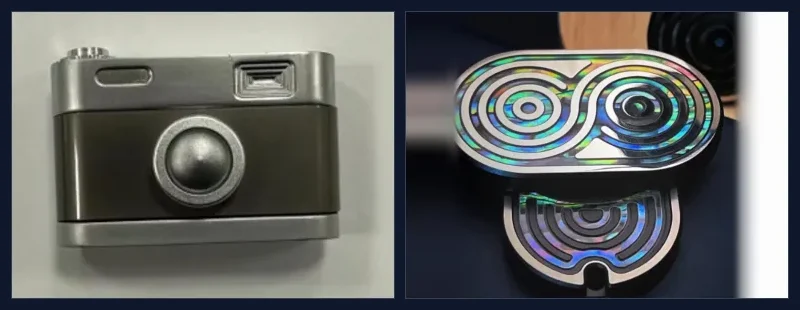
In low-grade street-market sliders, magnets are glued into shallow open surface dimples with brittle cyanoacrylate superglue that fractures after a single drop onto concrete or hardwood.
Every magnetic model across the FidgetSupply catalog (FS-001 through FS-150) enforces a 3-Layer Anti-Detachment Engineering Protocol:
| Retention Layer | Engineering Specification | Abuse Test Verification | Protected Catalog Lines |
|---|---|---|---|
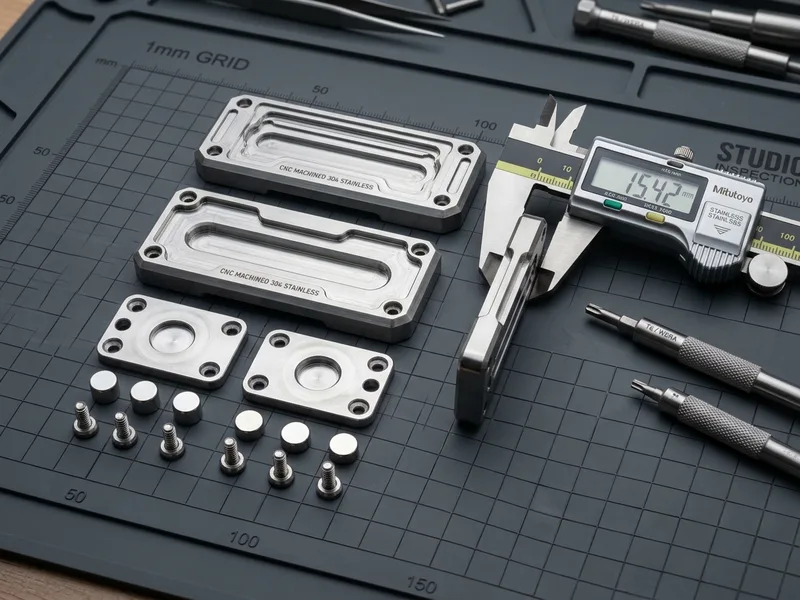
| Layer 1: Captive Blind-Pocket Cover Plates | Magnets sit inside internal counterbored blind cavities sealed beneath a CNC stainless steel or PTFE wear plate secured by 2 to 8 M2/M2.5 machine screws. | Zero physical exit pathway even if adhesive is thermally degraded | FS-001, FS-016, FS-094, FS-114, FS-125, FS-150 |
| Layer 2: Two-Part Structural Epoxy Bonding | Automated pneumatic dispensing of modified two-component structural epoxy/acrylic adhesive (>22 MPa overlap shear strength, -40°C to +120°C operating range) into chamfered wells. | 48-hour thermal shock cycle (-20°C to +80°C) + 10× 1.5m concrete drop test | All Magnetic Sliders, Coins, Gourds & Spinner Rings |
| Layer 3: Anaerobic Thread-Locked Fasteners | Every M1.6, M2, and M2.5 stainless Torx/Hex fastener and bearing retention nut is assembled with medium-strength anaerobic threadlocker (Loctite 243 equivalent). | 16 CFR 1500.53 Torque (0.45 Nm) and Tension (70 N) clamp verification | Multi-Action Mechanical EDC, Haptic Coins & Gimbal Gyros |
3. EU RoHS 3, REACH SVHC & California Prop 65 Metallurgy Standards
Because everyday carry fidgets remain in constant skin contact with the user’s fingers and palms for hours each day, chemical and heavy-metal safety is equally vital for US and European retail importers.
| Regulatory Standard | Restricted Substances & Limits | FidgetSupply Raw Material Control |
|---|---|---|
| EU RoHS 3 (Directive 2015/863) | Lead (<0.1%), Cadmium (<0.01%), Mercury (<0.1%), Hexavalent Chromium (<0.1%), Phthalates | Virgin Zamak #3 zinc ingots, trivalent chromium passivation, and XRF spectrometer screening on every batch |
| EU REACH SVHC & EN 1811 | 240+ Substances of Very High Concern; Nickel release <0.5 µg/cm²/week for prolonged skin contact | Medical/food-grade SUS304 & SUS316 stainless steel, hard-anodized 6063 aluminum, and nickel-free PVD coatings |
| California Proposition 65 | Total Lead <90 ppm in surface coatings and <100 ppm in accessible substrates; Phthalate-free EVA cases | Lead-free C36000 brass/copper alloys and virgin odorless 85-shore EVA zipper pouches |
| IATA DGR Packing Instruction 953 | Stray magnetic field strength <0.00525 gauss (0.525 milligauss) measured 4.6m from outer carton | High-permeability iron-sheet lined export cartons with pre-shipment flux-gate magnetometer certification |
4. Amazon Seller Central Compliance Packets & 30+ Magnet-Free Catalog Alternatives
When listing metal EDC products on Amazon US, UK, or EU, proper age-grading and documentation prevent automated compliance flags:
- 14+ Adult EDC Age-Grading & Warning Labels: All metal sliders, coins, and spinners are precision kinetic desk instruments graded for **Ages 14+ (Adult Everyday Carry)**. Never list heavy metal EDC sliders in the under-12 children's toy category. Every custom packaging order (Black EVA Zipper Case, Tin Box, or Gift Box) includes free application of compliant 14+ safety warning labels and Amazon FNSKU barcodes.
- Complete Documentation Packet: Confirmed wholesale buyers receive a General Certificate of Conformity (GCC), 16 CFR 1262 Magnet Retention Test Report, and XRF RoHS Material Verification Sheet.
- 30+ 100% Magnet-Free SKUs Available: If your distribution channel prefers zero magnet regulations altogether, over 30 models in our catalog contain **zero magnets**—including FS-005 (304 Stainless Knuckle Roller), FS-009 (Knurled Twist Top), FS-043 & FS-066 (Multi-Axis Gimbal Gyros), FS-061 & FS-079 (Chain Sprocket Spinners), FS-063 (316 Stainless Goose Spinner), FS-067 (Bolt-Action Slider), and FS-085 / FS-092 (Mechanical Spring Ratchets).
5. Step-by-Step CPSC 16 CFR 1262 Abuse Test Protocol at Our Fuzhou QC Lab
Before any bulk production lot leaves our Fuzhou Industrial Zone Export Hub, our quality assurance engineers execute a four-stage mechanical and thermal stress audit modeled directly on 16 CFR Part 1262 and 16 CFR 1500.53 abuse testing:
- Stage 1 — 48-Hour Thermal Shock Conditioning: Random sample units from Magnetic Sliders, Haptic Coins, and EDC Gourds are cycled between -20°C (-4°F) and +80°C (+176°F) to verify that differential thermal expansion between metal shells and NdFeB magnets never weakens the structural epoxy bond.
- Stage 2 — 10× 1.5-Meter Steel-Backed Concrete Drop Test: Each conditioned sample is dropped 10 times from a height of 1.5 meters onto a 3mm steel plate over concrete across six axial orientations (corners, edges, and flat faces). Passing criteria: zero magnet liberation, zero shell fracture, and zero screw loosening.
- Stage 3 — 0.45 Nm Torque & 70 N Tension Clamp Test: Threaded M2/M2.5 cover fasteners and rotary bearing caps on models like FS-013, FS-096, and FS-129 are subjected to axial pull and rotational torque to confirm threadlocker integrity.
- Stage 4 — XRF Heavy Metal & Gaussmeter Stray-Field Scan: Surface coatings are scanned via X-Ray Fluorescence (XRF) for Lead (<90 ppm) and Cadmium compliance, while packed master cartons are verified below 0.00525 gauss at 4.6 meters.
6. Customs HS Code 9503.00.0000, Packaging Warning Labels & Non-Magnetic Alternatives
For smooth US CBP, UK HMRC, and EU customs clearance, as well as rapid Amazon FBA receiving, we standardize both customs tariff classification and retail warning labels across all orders:
- Standardized HS Code & Commercial Invoice Descriptions: All metal fidget sliders, spinners, and desk toys export cleanly under harmonized tariff code 9503.00.0000 / 9503.00.8900 with complete material and magnet safety declarations.
- Compliant 14+ Adult EDC Packaging Warnings: When you order custom retail packaging (see our Custom EVA Zipper Case & Tin Box Packaging Guide), we print or apply mandatory "14+ Adult Everyday Carry Desk Instrument — Contains Sealed Internal Magnets" warnings alongside your Amazon FNSKU barcode at no extra charge.
- Explore Pure Mechanical & Bearing Collections: Want to expand your catalog with zero-magnet SKUs? Read our R188 Bearing Spinners & Desktop Gyros Guide and our Multi-Action Mechanical & Ratchet EDC Guide covering 30+ pure mechanical models in Metal Spinners & Gyros and Mechanical EDC Fidgets.
Need CPSC 16 CFR 1262 & RoHS Compliance Documentation for Your Order?
Contact our Fuzhou compliance and engineering team to review test reports, request compliant 14+ packaging dielines, or select from our locked-magnet and magnet-free catalog lines.
Request Compliance Packet & Wholesale Quote →