1. Why the R188 Miniature Bearing Defines High-End Metal Fidget Spinners & Desktop Gyros
In precision kinetic EDC hardware, the difference between a cheap promotional novelty spinner that grinds to a halt in 45 seconds and an heirloom-grade desktop instrument that spins silently for 4 to 7 minutes comes down to two engineering variables: bearing raceway tribology and polar moment of inertia ($I_z$).
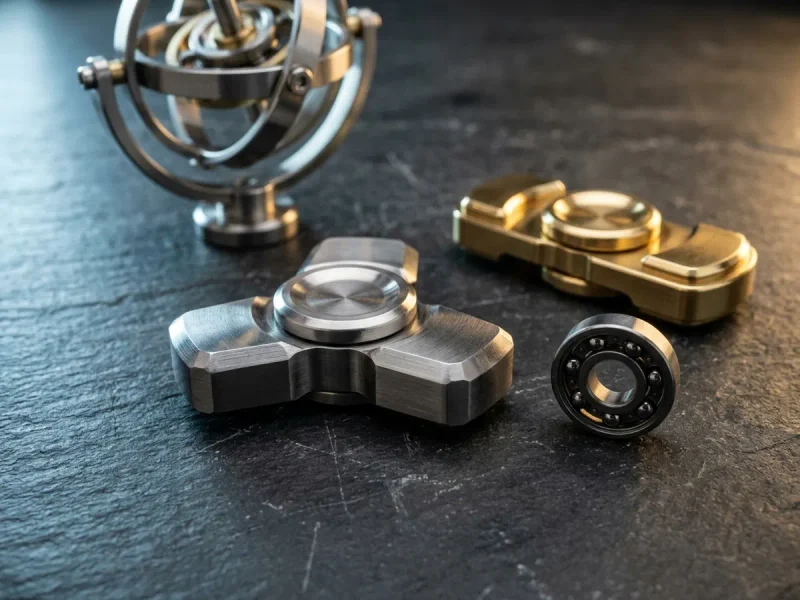
Across our Metal Fidget Spinners & Desktop Gyros collection (spanning 30+ active production molds from FS-008 through FS-148), we have standardized almost entirely on the imperial R188 miniature deep-groove ball bearing (1/4" ID × 1/2" OD × 3/16" width, or 6.35mm × 12.70mm × 4.762mm) over the bulky metric 608 skate bearing (8mm × 22mm × 7mm).
Why did the global EDC market abandon the 608 bearing in favor of the R188?
Because rotational drag torque inside a rolling-element bearing scales directly with the pitch circle diameter of the ball complement. By shrinking the bearing outer diameter from 22.0mm down to 12.7mm and utilizing a crown-less 10-ball full-complement raceway, the R188 cuts rolling friction by more than 62% while concentrating a higher percentage of the spinner’s mass at the outer perimeter.
2. 10-Ball Stainless vs. Hybrid Si3N4 Ceramic R188 Bearings: Tribology & Acoustic Matrix
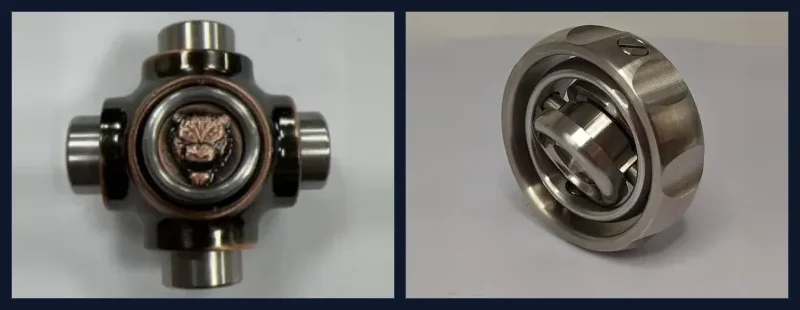
When configuring bulk orders for retail brands or corporate executive gifting, sourcing managers frequently ask whether to specify 440C Martensitic Stainless Steel R188 bearings or Hybrid Silicon Nitride ($\text{Si}_3\text{N}_4$) Ceramic R188 bearings.
Both bearing types run dry (unlubricated and degreased via ultrasonic solvent bath) to maximize free-spin duration, as even ultra-light synthetic oil films introduce viscous shear drag at 3,500+ RPM. However, their acoustic signature, axial feedback, and unit cost differ significantly:
| Bearing Specification | Ball & Raceway Metallurgy | Dry Free-Spin Time (95g Rotor) | Acoustic Noise Floor (at 30cm) | Tactile Gyroscopic Feedback | Recommended Production SKUs |
|---|---|---|---|---|---|
| Standard 8-Ball R188 (Caged) | GCr15 Chrome Steel balls + Nylon/Brass retainer cage | 1 min 45 sec – 2 min 30 sec | 44 – 48 dBA (Audible metallic whir) | Moderate vibration; economical entry-level feel | FS-009, FS-074, FS-139 |
| 10-Ball 440C Stainless R188 | 440C Stainless Steel balls & CNC-ground raceways | 3 min 30 sec – 5 min 00 sec | 34 – 38 dBA (Whisper-quiet butter spin) | Silky smooth, zero-chatter axial precessional torque | FS-008, FS-063, FS-134, FS-137 |
| Hybrid Si3N4 Ceramic R188 | Grade 5 $\text{Si}_3\text{N}_4$ black ceramic balls + 440C stainless races | 4 min 30 sec – 6 min 45 sec | 40 – 45 dBA (Crisp, airy high-RPM hiss) | Crisp micro-granular feedback; impervious to humidity corrosion | FS-043, FS-066, FS-118, FS-148 |
| Dual-Bearing & Planetary Chain | Primary R188 core + secondary orbital roller/sprocket bearings | 1 min 30 sec – 3 min 15 sec | 48 – 56 dBA (Mechanical gear & chain cadence) | Compound mechanical gearing + gyroscopic torque | FS-061, FS-079, FS-087 |
Key Engineering Takeaway on Bearing Selection
- Choose 10-Ball 440C Stainless Steel for executive desk toys and open-plan office environments (FS-139, FS-134, FS-063). The matched elastic modulus between 440C balls and 440C rings eliminates high-frequency chatter, yielding a glass-smooth spin below
38 dBA. - Choose Hybrid $\text{Si}_3\text{N}_4$ Ceramic when maximum spin time (
5+ minutes) and corrosion immunity in humid coastal climates are your primary marketing claims (FS-043, FS-118).
3. Polar Moment of Inertia: Why Perimeter Weight Beats Total Weight
A common misconception among first-time buyers is that a heavier spinner automatically spins longer. In rotational dynamics, angular momentum $L = I \cdot \omega$, where rotational inertia $I = \sum m_i r_i^2$. Because radius $r$ is squared, moving just 15 grams of tungsten, brass, or stainless steel out to a 28mm outer rim produces four times the rotational inertia of placing that same 15 grams at a 14mm hub radius.
We engineer our kinetic line across four distinct rotor architectures:
- Rim-Weighted Multi-Metal & Tungsten-Ball Rotors: Models like FS-076 (8-Bead Stainless Large-Bore Spinner) and FS-078 (Alpha 14-Ball Ring Magnet Spinner) press high-density steel or tungsten spheres into the extreme outer circumference of the rotor, maximizing $m r^2$ while keeping the center web thin.
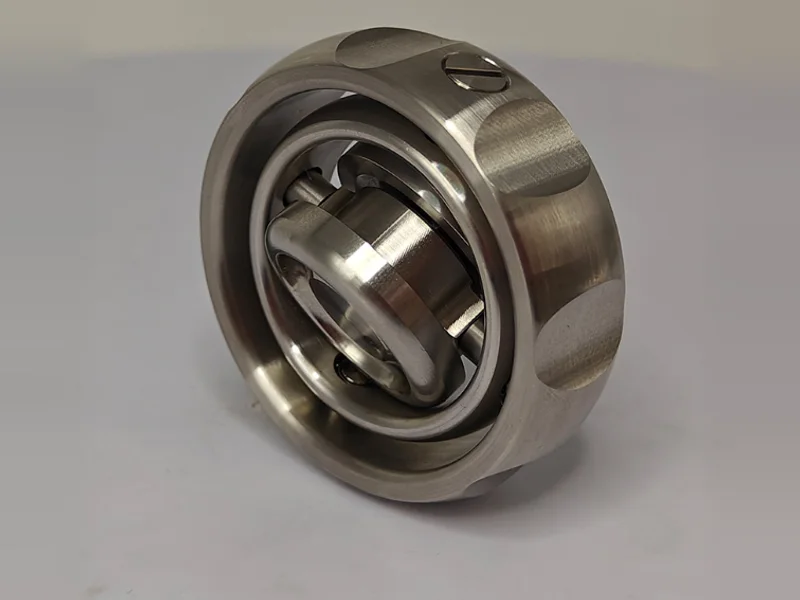
- Multi-Axis CNC Gimbal Desktop Gyros: Flagship architectural pieces such as FS-043 (6-Axis CNC Stainless Gyro Spinner), FS-066 (3D Multi-Axis Stainless Gimbal Gyro), and FS-118 (CNC 303SS Gimbal Gyro Model 7) nest 3 to 6 concentric CNC-turned 303/304 stainless steel rings on orthogonal pivot pins. When spun on a desk, each ring precesses independently, creating a hypnotic 3D kinetic sculpture.
- Sprocket & Roller-Chain Kinetic Spinners: Industrial-themed models like FS-061 (Dual-Sprocket Chain Drive Spinner) and FS-079 (Asymmetric Sprocket Chain Spinner) synchronize two or more bearings via miniature stainless steel roller chains, allowing users to either spin the entire assembly like a traditional gyro or roll the chain endlessly between thumb and index finger.
- Hybrid Magnetic-Kinetic & Tuning Fork Spinners: Crossover designs like FS-145 (18-Magnet Silicone Bumper Spinner) and FS-148 (Resonance CNC Stainless Tuning Fork Spinner) combine an R188 core bearing with secondary magnetic detents or cantilevered tuning-fork tines (see our Acoustic Tuning Fork EDC Engineering Guide).
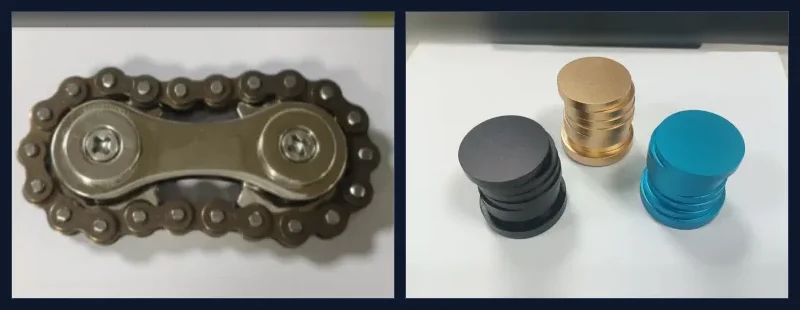
4. Threaded Retainer Rings vs. Press-Fit Bearing Housings: Serviceability & QC
How the R188 bearing is secured inside the metal rotor directly impacts both drop durability and after-sales maintenance. If a tiny dust particle enters an unshielded R188 bearing after six months of pocket carry, the end-user needs a way to clean or swap the bearing in 60 seconds without specialized arbor presses.
| Retention System | Mechanical Tolerance | User Bearing Replacement | Axial Runout (Wobble) | Wholesale QC & Longevity Rating |
|---|---|---|---|---|
| Threaded Brass/SS Retainer Ring | M14×0.5mm fine-pitch internal thread + notched spanner ring | 100% removable in 30 seconds using coin or key slot | ≤ 0.015mm (Zero outer race distortion) | Gold Standard — Used on CNC stainless & premium alloy models (FS-043, FS-134, FS-148) |
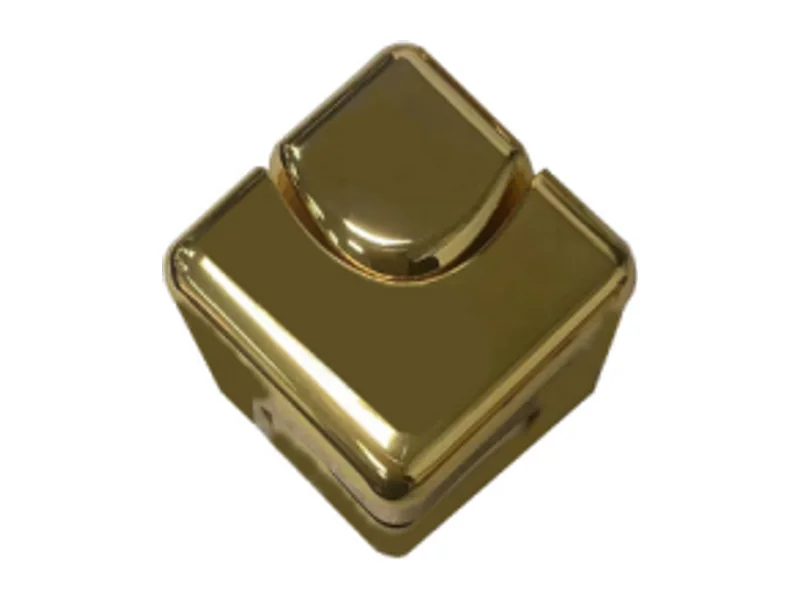
| Slip-Fit + Loctite 680 Retaining Compound | +0.01mm clearance bore bonded with anaerobic methacrylate | Factory-permanent (Ultrasonic cleaning in-place only) | ≤ 0.020mm (Stress-free raceway) | High Reliability — Ideal for compact desktop tops & cubes (FS-008, FS-009, FS-139) |
| Heavy Interference Press-Fit (Avoided) | -0.02mm interference bore pressed via hydraulic ram | Not serviceable without risking rotor deformation | 0.04mm – 0.08mm (Pinches outer race & kills spin time) | Phased Out — Radial compression distorts the 4.76mm R188 outer ring, reducing spin time by 40%+ |
Why do we strictly prohibit heavy interference press-fits on thin-walled R188 bearings? Because the outer ring of an R188 bearing is only 1.1mm thick. Pressing it into an undersized bore compresses the outer raceway inward by 5 to 12 microns, eliminating internal radial clearance (C0/C3 play) and binding the 10 balls against the raceway walls. By machining a slip-fit bore and locking the outer ring from above with a threaded M14 retainer ring or anaerobic retaining compound, radial raceway geometry remains 100% uncompressed.
5. Dynamic Balancing, Dish Concavity & Custom Logo Center Caps
For corporate gifting and private-label retail brands, the threaded center finger buttons (center caps) of a metal spinner or desktop gyro are the single highest-visibility branding real estate on the product.
Every R188 spinner in our catalog uses a male/female M3×0.5mm threaded spindle cap system machined from 303 stainless steel, H62 brass, or 6063-T6 anodized aluminum:
- Concave Dish Geometry: We machine a
1.2mm to 1.8mmspherical dish into both top and bottom finger pads (Ø18mm to Ø24mmdiameter) so the user’s thumb and index finger naturally self-center over the rotational axis without rubbing against the spinning rotor arms. - Zero-Spin-Distortion Branding: Because the center cap remains stationary between the user’s fingers while the outer rotor spins at 3,000+ RPM, engraving or printing your brand logo on the center cap ensures the logo stays 100% legible during operation! Compare our Fiber Laser Engraving vs. UV Printing Logo Guide for depth and durability specs.
- Metallurgy Cost Optimization: Need an accessible
$3.50–$6.50corporate gift? Choose CNC 6063 aluminum or die-cast zinc alloy rotors (FS-139, FS-008) from our Custom Logo Ready Wholesale collection. Targeting$45–$120retail collector pricing? Specify full 303/316 CNC stainless steel models (FS-063, FS-118) from our CNC Stainless Steel & Exotic Metals collection—detailed in our Zinc Alloy Die-Casting vs. CNC Stainless Steel Cost Guide.
6. 4-Point Factory QC Protocol for Kinetic Spinners & Custom Packaging Pairing
Before any wholesale batch of R188 spinners or desktop gyros leaves our Dongguan assembly line, every unit undergoes a 4-stage kinetic inspection:
- Ultrasonic Degreasing & Dry-Air Blowout: Bearings are cleaned in analytical-grade hydrocarbon solvent to strip factory anti-rust grease, restoring full dry-spin velocity.
- Optical Tachometer Spin-Duration Audit: Quality inspectors spin a statistical sample using a calibrated compressed-air nozzle at
0.4 MPaand verify both initial RPM (>3,200 RPM) and coast-down duration (>180 secondsfor standard stainless R188;>240 secondsfor hybrid ceramic). - Axial Runout & Wobble Check: Dial indicator verification ensures rotor tip runout remains under
0.05mm, preventing gyroscopic shudder when transitioning from horizontal to vertical axes. - Shock-Absorbing Packaging Pairing: High-mass kinetic rotors (
80g–155g) can damage standard paperboard tuck boxes if dropped during air freight. We pair all R188 spinners and gimbal gyros with die-cut high-density EVA foam inserts inside tin presentation boxes or waterproof zipper cases—explore full specs in our Custom EVA Cases & Tin Box Packaging Guide and 100-Piece Ready-Mold Private Label SOP.
Request Our R188 Kinetic Spinner & Desktop Gyro Evaluation Kit
Want to compare 10-ball 440C stainless steel vs. hybrid Si3N4 ceramic R188 bearings side-by-side? Contact our engineering desk to order a pre-configured kinetic sample kit (FS-008, FS-043, FS-061, FS-134, FS-139) with custom laser-engraved center caps.
Request Kinetic Sample Kit & Bulk Quote →